
On this page
- What types of screen and cover are there?
- Why do needles beat most screens?
- How do they cope with moss?
- Where do screens and covers make sense?
- Where do they cause trouble?
- How do you tell if a screen is failing?
- Can a screen be upgraded later?
- What do screens cost compared with mesh?
- Are reverse-curve guards hard to clean?
- Do screens suit outbuildings?
- What should a screen or cover quote include?
- Are covers safe in snow?
What types of screen and cover are there?
Call (425) 215-1852 to be connected with an independent contractor who can show you options for the trees around your house.
| Type | How it works | Stops | Lets through |
|---|---|---|---|
| Snap-in screen | Wire or plastic mesh clipped over the gutter | Large leaves | Needles, catkins, cones, grit |
| Perforated aluminum cover | Rigid sheet with punched holes | Leaves, most seeds | Needles if holes are large; grit |
| Reverse curve | Solid hood; water follows the curve into a slot | Leaves | Grit that builds on the curve |
| Foam insert | Foam block filling the gutter | Some leaves | Slowed water; holds debris |
| Brush insert | Bristles in the trough | Some leaves | Needles tangle in the bristles |
Why do needles beat most screens?
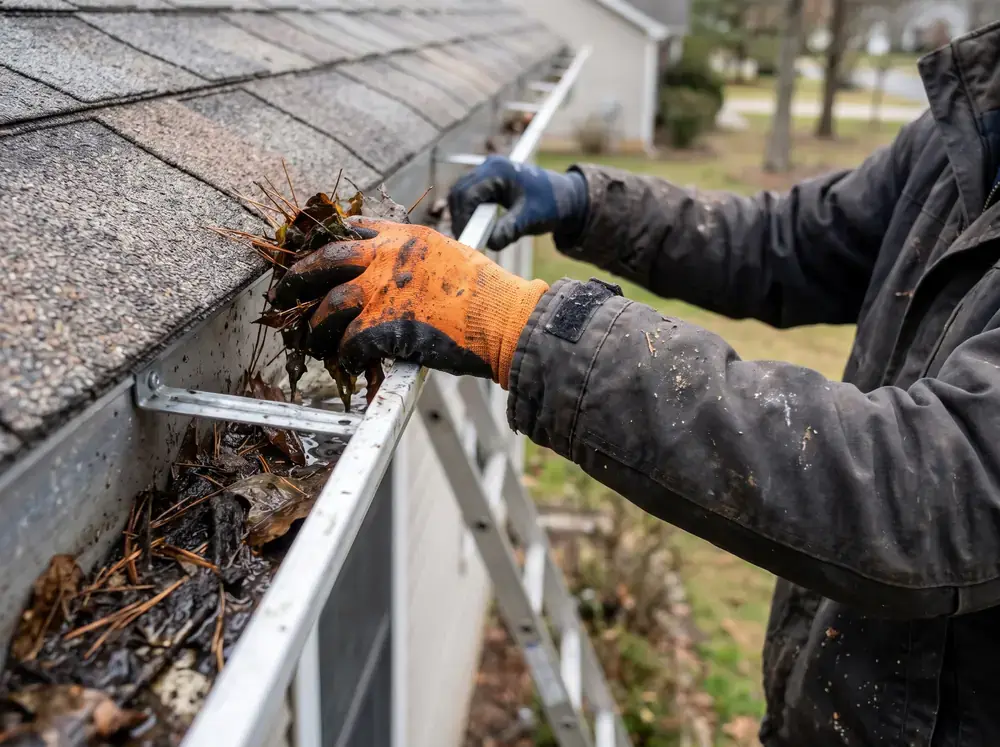
Their shape. A fir or cedar needle is long and narrow, so it slides lengthwise through any opening wider than itself. Once through, it lies across the outlet. Screens and covers with larger openings handle maple and alder leaves well but often fill the outlet under conifers while looking clean from the ground. See micro-mesh gutter guards.
How do they cope with moss?
Not especially well. Moss on the roof sheds grit and clumps through the wet months, and Seattle Public Utilities notes it revives with the rain from early winter. Grit lodges in screen openings and builds up on reverse-curve hoods, slowing the water. Foam and brush inserts hold it like a sponge. Whatever the guard, clearing moss from the roof edge helps it work.
Where do screens and covers make sense?
- Broadleaf trees only, with no conifers overhead.
- A short-term fix on gutters due for replacement in a few years.
- Low, single-storey eaves, where lifting a screen to clean is easy.
- Porches and garages, where debris is light.
Where do they cause trouble?
- Under conifers, where needles pass through.
- On mossy roofs, where grit clogs the openings.
- With foam and brush inserts, which hold wet debris and break down.
- When they hide a blockage, so the gutter spills while looking clean.
How do you tell if a screen is failing?
Look for water spilling over the front in moderate rain and little water from the downspout. Lift a section near each outlet after the leaf drop and look underneath. If needles have built up below the screen, it is time to clear it or move to a finer guard.
See gutter guards and are gutter guards worth it?.
Can a screen be upgraded later?
Yes. Snap-in screens are easy to remove, and the gutter can then take a micro-mesh guard if it is sound. Many homeowners start with screens and upgrade when they find needles getting through.
What do screens cost compared with mesh?
Less. Screens and perforated covers are the cheapest guards, and snap-in types can be fitted by a homeowner on low eaves. Stainless micro-mesh costs more but lasts longer and stops needles. Compare per-foot prices and warranties.
Are reverse-curve guards hard to clean?
They can be. Grit and algae build on the curved surface and in the slot, and cleaning means brushing the curve and clearing the slot from a ladder. On mossy roofs, that may be needed as often as cleaning an open gutter.
Do screens suit outbuildings?
Often. Sheds, garages and carports with low eaves and light debris are good places for inexpensive screens, because lifting them to clean is easy. Under conifers, the same caution applies: needles get through.
What should a screen or cover quote include?
The product name and type, the gutter size it fits, how it attaches, whether gutters will be cleaned and resealed first, the per-foot price and the warranty. Comparing these side by side against a micro-mesh quote shows the real difference in cost and coverage.
Are covers safe in snow?
Solid covers can let snow slide off the roof edge more readily. Plan where it will land, away from steps.